
Wheel misalignment frequently triggers Electronic Stability Control (ESP) lights by creating a data mismatch between steering sensors and wheel speed. When a crooked steering wheel conflicts with the vehicle’s true path, the computer perceives a skid, potentially activating ghost braking. Simon’s Auto Repair in Taunton provides the precision recalibration needed.
The dashboard of a modern family sedan is a nervous system of sensors, and when your alignment is out of spec, that system begins to fail. Beyond simple tire wear, a crooked steering wheel sends conflicting data to your car’s brain, often resulting in a persistent Electronic Stability Control (ESP) light. At Simon’s Auto Repair, we bridge the gap between mechanical precision and digital calibration to ensure your safety systems remain active.
Electronic Stability Control 101 and How Sensors Read Your Alignment
Modern vehicle safety is a high-speed conversation between hardware and software. Your Electronic Stability Control (ESP) acts as the conductor of this orchestra, constantly monitoring vehicle behavior to prevent skids and rollovers. Rather than seeing the road, it interprets a stream of data from three primary sources:
- Steering Angle Sensor (SAS): This tracks the exact position of your steering wheel to determine your intended direction.
- Wheel Speed Sensors: These monitor the rotational speed of each tire to detect loss of traction or hydroplaning.
- Yaw Rate Sensor: Functioning as an internal gyroscope, this detects the vehicle’s actual rotation around its vertical axis.
For the ESP to function, this data must be plausible. If you are traveling straight down Somerset Ave, your wheel speed sensors should report equal speeds while your SAS reports zero degrees. When a misalignment forces you to hold the wheel at an angle just to maintain a straight path, the plausibility breaks. The computer perceives a steering input without a corresponding change in the car’s rotation, leading it to conclude the vehicle is sliding even on dry pavement.
The Plausibility Fault and Why Your Car Thinks It Is Skidding
This logical conflict triggers what technicians call a Plausibility Fault. In Taunton’s residential neighborhoods, a simple curb strike during a winter flurry can knock your toe angle out by a fraction of an inch. While the car may still feel drivable, the ESP system becomes hyper-vigilant.
When the computer detects a mismatch between where the wheels are pointed and where the steering wheel is held, it may initiate a Ghost Intervention. You might feel a sudden pulsing in the brake pedal or a momentary loss of engine power while driving on a perfectly dry surface. The car isn’t failing mechanically; it is trying to correct a skid that doesn’t exist because its sensors are being fed bad data by a crooked alignment.
Thrust Angle Errors and Ghost Braking on the Route 24 Highway Merge
Rear-axle alignment, or Thrust Angle, is equally critical for electronic safety. If your rear wheels are misaligned, the car will dog-track, moving down the road at a slight diagonal. On high-speed stretches like the merge from Route 140 onto Route 24 North, this creates a massive headache for the ESP system.
As you navigate the curve of the on-ramp, the Yaw Rate Sensor detects the rotation of the car, but the Thrust Angle error makes that rotation appear exaggerated or erratic. This often results in the traction control light flickering unnecessarily or, in severe cases, the car applying the brakes to a single wheel to pull the chassis back into what it perceives as a safe line. This unexpected braking at highway speeds is more than a nuisance; it is a significant safety risk for Taunton families.
Simon’s Precision Protocol and Clearing the Fault with a Digital Zero Reset
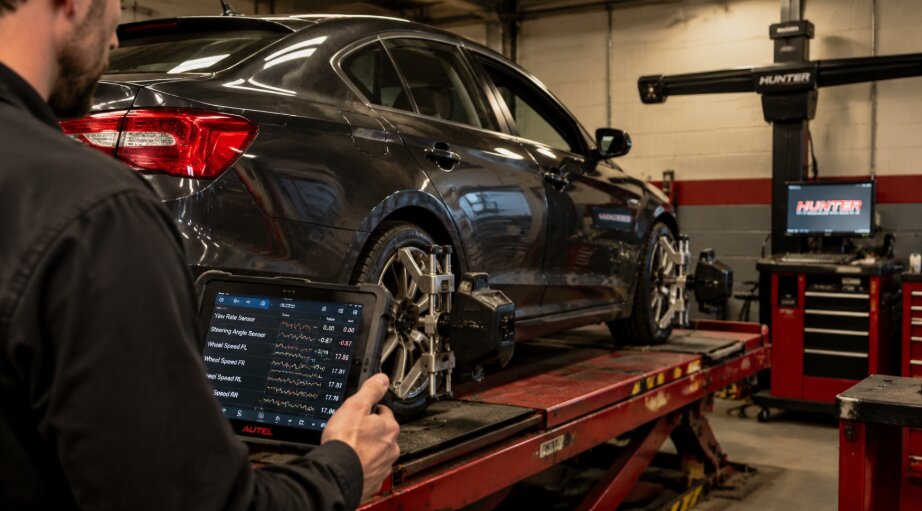
At Simon’s Auto Repair, we recognize that an ESP light is not a suggestion; it is a total system shutdown. While many shops simply use a scan tool to clear the code, the light will inevitably return the moment the car exceeds 15 mph and the computer re-runs its self-diagnostics. Our recovery protocol involves a two-stage synchronization:
- Mechanical Correction: We use the Hunter HawkEye Elite to physically square the wheels and center the steering rack, eliminating the root cause of the sensor mismatch.
- Digital Zero Reset: Using the Autel MaxiSYS Ultra, we perform a recalibration that teaches the ESP computer that the new, centered position is the true Zero point.
- Live Data Verification: We monitor sensor output in real-time during a test drive to ensure the SAS and Yaw Rate data are perfectly synchronized under load.
This comprehensive handshake between metal and software is the only way to permanently extinguish the warning light. We don’t just hide the symptom; we restore the communication loop that allows your car to protect you in a crisis.
Simon’s Precision Protocol and Clearing the Fault with a Digital Zero Reset
At Simon’s Auto Repair, we recognize that an ESP light is a total system shutdown. Our recovery protocol involves a two-stage synchronization:
- Mechanical Correction. We use the Hunter HawkEye Elite to physically square the wheels and center the steering rack.
- Digital Zero Reset. Using the Autel MaxiSYS Ultra, we perform a recalibration that teaches the ESP computer that the new, centered position is the true Zero point.
- Live Data Verification. We monitor sensor output in real-time during a test drive to ensure the SAS and Yaw Rate data are perfectly synchronized under load.
This comprehensive handshake is the only way to permanently extinguish the warning light and re-enable your safety features.
Simon’s Auto Repair | 678 Somerset Ave, Taunton, MA | Performance Geometry Specialists
Frequently Asked Questions
Can a bad alignment cause my Traction Control light to come on?
Yes. If your steering wheel is off-center due to misalignment, the car’s computer thinks you are turning while the wheels are going straight. This conflict triggers the Traction Control or ESP light.
Will my safety features work if the ESP light is on?
No. Most modern vehicles will disable Traction Control, Stability Control, and even Emergency Braking if the ESP system detects a sensor mismatch. Your car will revert to basic braking without electronic assistance.
Why did my light come back on after another shop cleared it?
No, clearing the code is not a fix. The computer re-checks the sensors every time you drive. If the mechanical alignment isn’t fixed, the computer will detect the same error and turn the light back on immediately.
Does a “curb strike” always require an alignment?
Yes. Even a minor impact can shift the toe angle enough to confuse the SAS and Yaw sensors. It is better to have it checked at Simon’s before the system triggers a “Limp Mode” or disables your safety features.
