
Navigating downtown Taunton involves constant tight-radius turns and high-torque parking maneuvers that punish front-end suspension components. Unlike highway travel, city driving forces wheels to pivot at extreme angles, causing tires to scuff and ball joints to wear prematurely. Simon’s Auto Repair provides precision alignments tailored for urban agility and long-term part protection.
Downtown Taunton is a mechanical gauntlet that challenges even the most resilient suspension systems. While highway miles are relatively predictable, the constant lock-to-lock steering required to navigate the Taunton Green or parallel park near Main St places immense horizontal stress on your front-end components. At Simon’s Auto Repair, we understand that city driving requires a specialized approach to wheel alignment—one that prioritizes maneuverability, steering returnability, and the protection of your tire edges against the friction of tight urban turns.
Ackermann Geometry and the Science of Turning Tight Corners
When your car navigate the rotaries at the Taunton Green, your car is performing a complex geometric dance. Because the inside wheel follows a smaller circle than the outside wheel, it must turn at a sharper angle to prevent the tires from dragging. This mechanical principle is known as Ackermann Steering Geometry.
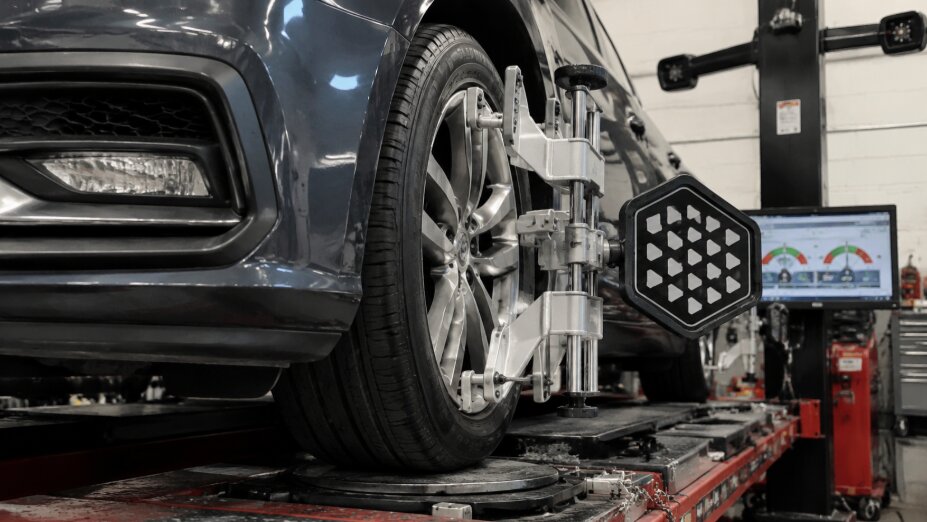
If your alignment is even slightly out of specification, this geometry breaks down. Instead of rolling smoothly through the turn onto Broadway, the tires begin to fight each other. One tire will roll while the other scuffs sideways across the asphalt. This creates the chewed up or feathered outer edges that Taunton drivers often notice on their front tires after a season of heavy downtown commuting. We use the Hunter HawkEye Elite to measure Toe-Out on Turns, ensuring your wheels maintain their geometric harmony even at full steering lock.
The Dry Steering Trap and How Slow Maneuvers Shred Ball Joints
One of the most damaging habits for a front end is dry steering—turning the steering wheel while the vehicle is stationary. This is a common necessity when parallel parking near Post Office Square or navigating tight construction detours. Without the forward motion of the car to ease the transition, the power steering system exerts massive hydraulic pressure to force the tires to pivot.
This torque is absorbed entirely by the Lower Ball Joints and tie-rod ends. Over time, this pressure creates microscopic gaps, or play, within the joint’s socket.
Even 0.05” of play is enough to allow the wheel to lean or tilt during a turn. This shift ruins your alignment mid-maneuver, meaning your car is only aligned when driving straight. At Simon’s, we perform a physical load test on these joints before every alignment; if the pivot points are loose, the alignment won’t hold, and your tires will continue to suffer.
Navigating the Green and Why Your Steering Wheel Feels Heavy
If you find that navigating the transition between Winthrop St and Main St feels like a physical workout, the culprit is likely your Caster angle. Caster is the forward or backward tilt of the steering axis. It is the same principle that allows a shopping cart’s wheels to follow the handle.
- Returnability. Proper positive caster is what causes your steering wheel to snap back to center after completing a turn onto Court Street.
- Directional Stability. Without the correct caster, the car feels nervous at speed but heavy and sluggish during downtown maneuvers.
- May Road Conditions. With the current DPW milling and resurfacing on Hart St and Tremont St, uneven road surfaces can amplify caster issues, making the car pull violently toward ruts or raised manhole covers.
Simon’s Precision Protocol and Aligning for Agility and Edge Protection

At Simon’s Auto Repair on Somerset Ave, we recognize that a highway alignment is insufficient for a city driver. Our protocol includes the use of precision Turn Plates. These plates allow the wheels to move freely during the alignment process, simulating the high-friction environment of a downtown turn.
We prioritize centering the rack and squaring the wheels to the vehicle’s true thrust line. This ensures that whether you are making a U-turn near the Taunton Public Library or navigating the tight radius of the Green, your tires are rolling with the least amount of resistance. This precision doesn’t just save your tires; it reduces the workload on your power steering pump and rack, extending the life of the entire steering system.
Beyond the Rack and Inspecting the Pivot Points of Your Suspension
A computer screen showing green lights is only half the story. The physical integrity of the rubber bushings and metal joints determines if that alignment stays true when you hit a bump on Main St.
As part of our May safety initiative, we inspect for bushing delamination—where the rubber inside your control arms begins to tear away from its metal sleeve. This is a common failure point for cars that frequently navigate Taunton’s stop-and-go traffic and construction zones. By catching these soft failures early, we prevent the sudden alignment shifts that lead to emergency repairs and ruined tire sets.
Simon’s Auto Repair | 678 Somerset Ave, Taunton, MA, 02780 | The Trusted Authority for Total Chassis Precision
Frequently Asked Questions
Does a “popping” sound when I turn the wheel while parking indicate a failing ball joint or a worn tie-rod end?
Yes, this is a primary symptom of a failing ball joint or a worn tie-rod end. The sound occurs when the joint’s internal ball jumps within its worn socket under high torque. It is a clear sign that your alignment is compromised.
Can city driving ruin my alignment faster than highway driving?
Yes. The frequent lock-to-lock steering, dry steering during parking, and the constant pivoting required for city rotaries put significantly more mechanical stress on the steering linkage than driving in a straight line on the highway.
Is it normal for my steering wheel not to return to center after a turn?
No, this is not normal behavior. It usually indicates that your Caster angle is out of spec or that a steering component is binding. It makes the car difficult to navigate in tight spaces like downtown Taunton.
Will an alignment fix the “scuffing” sound I hear during tight turns?
Yes. If your Ackermann geometry is incorrect, your tires are literally dragging sideways during turns. A precision alignment ensures both front wheels follow their intended radius, eliminating the scrub.
Is an alignment check recommended for city drivers every 6 months?
Yes, we recommend a check every 6 months or whenever you notice the steering wheel isn’t perfectly centered. Given the current May construction projects on Hart and Tremont Streets, a spring check is vital to protect your tire investment.
